Booking a flight for a two-week vacation? Easy. Booking one when you’re moving to Vietnam for three months, six months, or who knows how long? That’s a whole different game, and it changes what’s worth caring about.
When you start looking for business-class flights to Vietnam for a trip from the US, the seat and the fare are only part of the decision. Most travelers flying from the States will have to connect somewhere, and the journey is already a long haul before the layover even enters the equation.
And then there’s the piece I think people miss most often: where do you want this adventure to begin and end? If you’re staying for months, it might make way more sense to land in one Vietnamese city and fly home from another, and that changes how you should be searching for your ticket from the very start.
So before I let myself fall for any particular airline or business-class seat, I’d pin down my arrival and departure cities first. Once those are set, the route, the layover, and the cabin all start clicking into place!

The Routing Map
Here’s the reality: nearly every flight between the US and Vietnam comes with a layover. The one exception is Vietnam Airlines’ nonstop from San Francisco (SFO) to Ho Chi Minh City (SGN), the only nonstop route connecting the two countries.
It flies four days a week and clocks in at a bit over 16 hours. Sure, that’s a lot of hours in the air, but I’ll take settling in once over breaking things up with a stop at another airport halfway through.
If San Francisco works as your starting point and Ho Chi Minh City is where you want to land, this is as simple as it gets: one marathon flight, zero layovers.
And if sleep and personal space are a big reason you’re splurging on business class, the plane itself deserves a look too. Vietnam Airlines has flown this route with both Boeing 787s and Airbus A350s, and each one has fully flat business-class beds. Every seat on these planes also opens straight onto the aisle, which I love on a flight this length. No climbing over a sleeping neighbor just to stretch your legs!
Starting somewhere else in the US, or heading to Hanoi, Da Nang, or any city other than Ho Chi Minh? Then count on at least one connection. No nonstop flights leave the East Coast for Vietnam, so you’ll be switching planes either in Ho Chi Minh City or at another hub in Asia on your way in.
When that’s you, don’t stress about dodging a layover altogether. Put your energy into picking one that doesn’t tack extra hours onto a trip that’s already plenty long.
Business Class to Vietnam: The Connection Choices
If the San Francisco flight isn’t a fit for your plans, you’ll most likely be routing through Tokyo, Taipei, Seoul, or Singapore. All four hubs run regular onward flights to Ho Chi Minh City, Hanoi, and Da Nang, so stopping in one of them is just how most people get to Vietnam from the US.
This is also where I’d stop judging by the airline name alone and start digging a little deeper.
You can book business class for the entire trip and still end up in two completely different seats: one on the big flight across the Pacific, and another on the shorter hop into Vietnam. The transpacific seat is where you’ll spend the bulk of your travel time, so I’d want to know exactly what I’m getting there before handing over my money. I’d check what the second flight looks like too.
ANA Through Tokyo
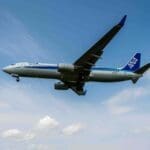
With ANA, the aircraft makes a real difference, so it’s the first thing I’d look up. On some of its Boeing 777-300ERs, you get THE Room, the airline’s most private business-class seat, with a fully flat bed, direct aisle access, and a sliding door.
Some Boeing 787-9s are now being fitted with THE Room FX, a newer take on that same private setup. Others still fly ANA’s older Business Staggered seat. You’ll still get a fully flat bed and your own path to the aisle, but it feels a lot more open and less private.
So all three give you a proper bed. What changes, and by quite a bit, is how much privacy comes with it. That’s why I’d pull up the seat map every single time before booking, instead of assuming one ANA business-class flight feels like the next.
Once you know which seat you’re getting, turn your attention to what happens after Tokyo. ANA flies nonstop from there to both Hanoi and Ho Chi Minh City, and other airlines run nonstops to Da Nang. That puts all three cities within easy reach from this hub! Just confirm which carrier operates that last stretch.
Korean Air Through Seoul
Korean Air’s business cabin goes by Prestige Class, but don’t expect every Prestige seat to be created equal.
The top of the line is Prestige Suites 2.0. Every passenger gets a fully flat bed, extra privacy, and aisle access without squeezing past anyone. It’s on the Boeing 787-10, and some refurbished 777-300ERs will get it too once those roll out.
Over on the Boeing 787-9, you’ll find the earlier Prestige Suite. The seats there still convert to a fully flat bed, just with a less enclosed feel. Some older aircraft go even further in that direction, with more open layouts and less separation between you and your neighbors. Worth spending a minute on the seat map here as well!
Good news for the final leg, though: Seoul has lots of options. Korean Air flies nonstop to Ho Chi Minh City, Hanoi, and Da Nang, so you can head straight to whichever Vietnamese city suits you best, no extra stop required.
EVA Air Through Taipei
EVA Air keeps things a lot simpler. Its business class is called Royal Laurel Class, and on both the Boeing 787 and the 777-300ER you’ll get a fully flat bed with nobody between you and the aisle.
That makes the flight across the ocean refreshingly easy to size up. Want to land in Asia after sleeping well instead of dozing on and off? Either plane gets you a real bed for the Pacific crossing.
Taipei is a great pick for keeping the rest of the trip simple, too. EVA flies nonstop from there to Ho Chi Minh City, Hanoi, and Da Nang, so you get to choose the city that fits your plans instead of funneling everything through a single arrival airport. So much easier!
Singapore Airlines Through Singapore
With Singapore Airlines, the plane I’d keep the closest eye on is the second one on the itinerary.
Leaving the US, you’ll usually be on an Airbus A350-900, though some routes use the Boeing 777-300ER instead. Both come with a fully flat business-class bed and direct aisle access, so there’s not much to figure out for the long flight.
Where it gets interesting is the shorter hop from Singapore to Vietnam. That flight can feel noticeably different, which is exactly why I’d never assume “business class all the way” means the same seat all the way.
Heading to Ho Chi Minh City? Singapore Airlines mixes widebodies with the smaller 737-8 on that route, so I’d confirm which plane you’re booked on before paying. If you end up on a 787-10, every business-class seat on that plane still lies fully flat with straight access to the aisle, so your comfort doesn’t take a big hit.
Hanoi and Da Nang call for a closer look. Some Hanoi flights, plus the current Da Nang service, use that smaller Boeing 737-8. Business class still has a fully flat bed, which is honestly impressive on a single-aisle plane! The cabin just feels tighter, and not every seat gets the same easy access to the aisle.
Would any of this put me off connecting in Singapore? Probably not. That last flight into Vietnam is only a few hours, and I’d much rather know about the switch ahead of time than find out as I’m boarding.
One more thing I’d look at, whichever hub you pick: the layover. A flat bed across the Pacific is what makes business class so worth it on a trip this far, and I want to land in Vietnam still feeling the benefit. Half a day stuck waiting for a connection would undo a lot of that good sleep. So if I had to choose, I’d take a slightly older business-class seat with a shorter layover. The older seats I’ve mentioned still fold into a flat bed, so what I’d give up is a bit of privacy, not the rest I’m paying for.
Booking for a Long Stay, Not a Vacation
Okay, this is the part where planning three months in Vietnam really starts to look different from planning a vacation.
For a stay that long, I wouldn’t just assume I have to fly in and out of the same city. Maybe I’d land in Da Nang, take my time heading north, and wrap things up in Hanoi.
Going all the way back to Da Nang just to catch my flight home? That’s extra time, one more domestic flight, and probably a hotel night I never needed.
Enter the open-jaw ticket, which is made for exactly this. The simplest way to picture it is a round trip that uses two different cities on one end. You could fly from New York to Da Nang, spend the next few months exploring Vietnam at your own pace, then fly home to New York from Hanoi.
Your ticket takes care of those two international flights. Getting from Da Nang up to Hanoi is on you, and you sort that out once you’re in the country.
And how you search for this trip matters a lot.
If you look up New York–Da Nang and Hanoi–New York separately, you’re asking for two standalone one-way tickets. International one-way business-class fares can be priced very differently from a return itinerary. An open-jaw search treats those flights as parts of the same trip instead of automatically asking the system for two separate one-way tickets. Under standard fare rules, each international flight can then be priced based on the round-trip fares that apply.
Now, that doesn’t guarantee every open-jaw ticket will cost the same as a regular round trip. The final price can still shift with your dates, the airline, and whatever fares are available when you book.
But it does mean an expensive pair of one-way searches isn’t your only way to fly into one Vietnamese city and home from another. Most of the big flight-search sites have a multi-city option for exactly this kind of trip. It’s just surprisingly easy to scroll right past it!
As for how long you’re staying, that part’s way simpler.
Under standard international ticketing rules, a ticket is normally good for 12 months from the day you start traveling, unless the fare you buy comes with a shorter validity period. So spending three months, six months, or even longer in Vietnam doesn’t automatically mean hunting down some special “long-stay” business-class ticket.
You’ll still want to read the maximum-stay, change, and other conditions on your specific fare, but a several-month trip isn’t an issue just because it’s long. Once I know I’m flying into one city and home from another, I would stop fiddling with multi-city searches and go through BusinessClass.com. Open-jaw routing is everyday work for them, so you can save time and avoid a few ugly quotes.
One more thing to confirm before you lock in those dates is Vietnam’s current entry and visa requirements. They can depend on how long you’re staying and how your trip is set up, so check the official rules before buying a ticket for a several-month stay.
First Things First: Your Two Cities
If you take one thing from all of this, make it the order you do things in. Your arrival and exit cities come first, because they decide whether this is a round trip or an open-jaw, and that decides whether the price you see reflects the real cost. Treat the journey as two one-ways, and every airline option that follows rests on a number that was never right to begin with.
Airlines, hubs, and seats can wait. Once you know the shape of the trip, those choices get much simpler.
So start there. Choose where you’ll land and where you’ll fly home from, and plan those two flights as one trip.
Read Next
Couple’s Vacation Guide to O’ahu, Hawai’i
The Perfect One Week in Bali Itinerary for First-Time Visitors
Ultimate Nias Indonesia Surf and Travel Guide
Top 5 Beaches in Florianopolis, Brasil
Pedra do Telegrafo Hike, Rio de Janeiro: All You Need to Know
Rio de Janeiro vs Florianopolis: Which Brazilian City is Better?
Ultimate Florianopolis Brazil Travel Guide: Surf, Eat, Explore
Praia do Rosa Brazil Travel Guide
Visit Macau: Las Vegas of the East
Travel to Puerto Escondido, Mexico with Me!
My Digital Nomad Life in Batukaras, Indonesia