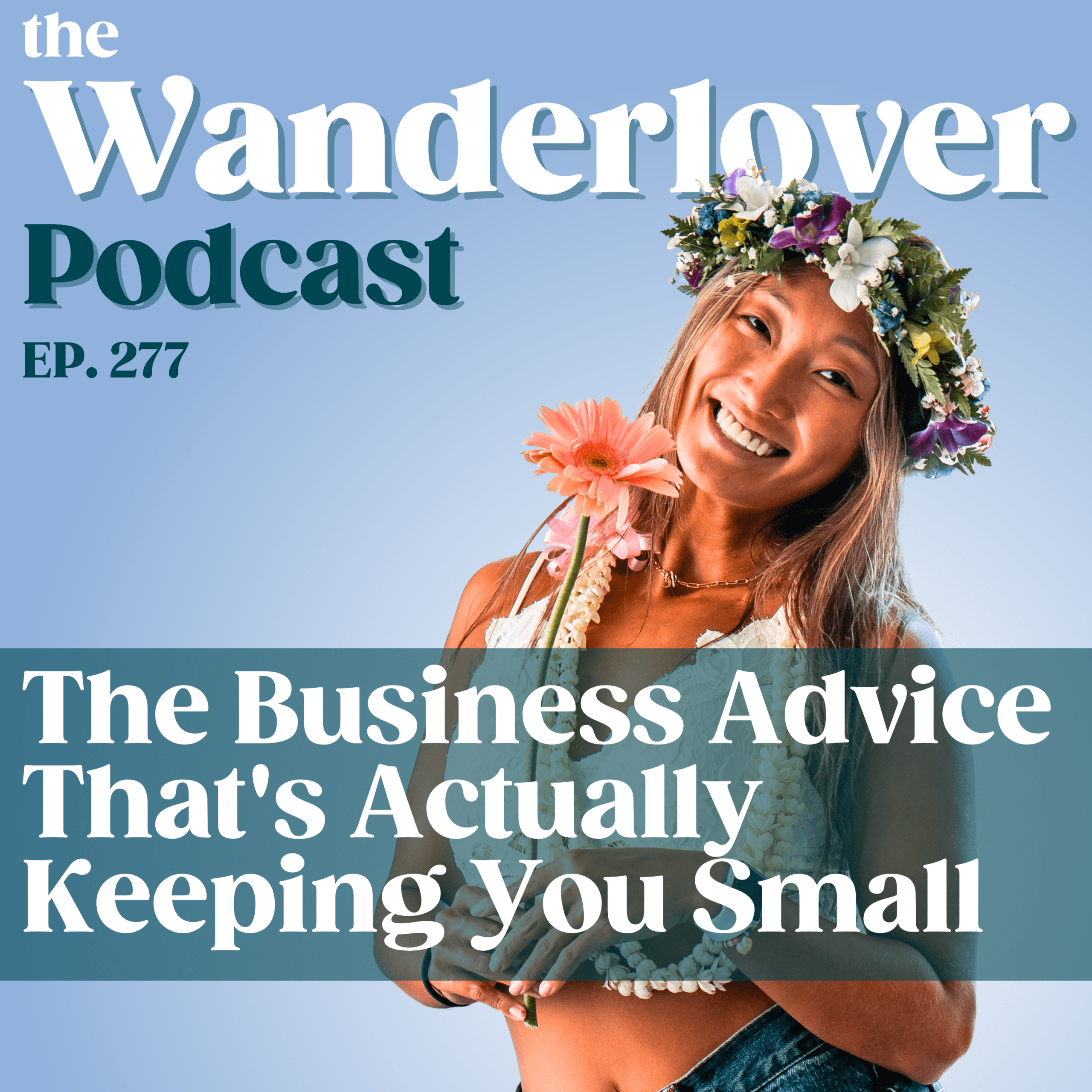
Tune in or read the blog version below!
Quick Links
✧ Join The Wanderlover Coaching Group
✧ Download Your FREE 0 to $100K Game Plan
Why Most Business Growth Advice Keeps You Stuck
Most business growth advice will keep you broke.
I know that sounds dramatic, but I want you to think about the last piece of advice you got about growing your business. Maybe it was “post more content.” Maybe it was “show up consistently.” Maybe it was “build your email list.” And I’m not saying those things are wrong, I’m saying they’re the last thing you should be focused on.
Because here’s what nobody tells you: the reason most coaches and creators aren’t growing isn’t because they’re not doing enough. It’s because they’re doing too many of the wrong things with total confidence.
Today I’m going to walk you through the four things I wish someone had told me when I was stuck — and I mean genuinely, embarrassingly stuck — in my business. These aren’t feel-good tips. They’re the shifts that actually moved the needle.
The Phase Most Coaches Get Stuck In Before Scaling
Before I get into the actual tips, I want to be clear about who this video is for, because I’m going to be pretty specific.
If you’re a coach or a creator building a business around what you know, then this video is for you. If you’re trying to scale past that ceiling — you know the one, where you’re making some money, doing all the things, but it’s not clicking the way you thought it would? This is for you.
I’m not talking about going from zero to your first dollar today. I’m talking about what happens after that. When you’ve proven the concept, you’re getting clients, but you can’t figure out why it’s not compounding or scaling exponentially. Why it feels like you’re pushing a boulder uphill every single month.
I spent over a year in that exact place. And the four things I’m about to share are what got me out of it. Let’s start with the one that took me the longest to see.
Tip 1: Why You’re Tracking the Wrong Growth Metric
Tip number one: you are almost certainly optimizing the wrong metric.
You are focusing your energy on the wrong number.
Here’s what I mean. When I first started growing my business, I was obsessed with my follower count. And I know, I know — you’ve heard people say “followers don’t matter,” and you’ve half believed it, but you still refresh the number. I did too. Because it feels like growth. It looks like growth. Other people can see it.
But followers are a lagging indicator. They tell you what already worked. They don’t tell you what’s working right now.
The number that actually predicts whether your business grows next month is this: how many qualified conversations are you having per week?
Not DMs. Not comments. Actual conversations, so voice notes, calls, real back-and-forth exchanges — with people who could become clients or customers or who already are clients and customers. That number tells you everything.
When I started tracking that instead of followers, something weird happened. I realized I was having maybe two or three real conversations a week. And some weeks, zero. I was posting consistently, getting decent engagement, and having essentially no conversations that could lead to revenue.
Here’s the reframe: your business grows at the speed of trust. And trust is built in conversation. Content builds awareness. Content builds interest. But it doesn’t close the gap between “I follow this person” and “I gave this person money.” Conversation does that.
So the shift is this — before you ask yourself “how do I get more followers” or “how do I get more reach,” ask yourself: how many real conversations did I have this week? If the answer is less than five, that is your growth problem. Not your content.
Write that number down this week. Just track it. You’ll be surprised what you find.
Tip 2: Why Your Offer Matters More Than Your Marketing
Okay, tip two. And this one is going to sting a little, so stay with me.
Most people with a stagnant business don’t have a marketing problem. They have an offer problem.
I used to think — and I hear this from so many coaches — “I just need to get in front of more people. If I could just get more eyes on what I’m doing, the sales would come.” And so you run ads, or you do a collab, or you go viral once, and… it doesn’t convert the way you expected. And you think, “Okay, I just need better marketing.” And you hire a strategist, or you take a course, and still — nothing.
The uncomfortable truth is that marketing can only amplify what’s already there. If your offer isn’t clear, isn’t compelling, and isn’t solving a specific problem for a specific person — more eyeballs just means more people saying no faster.
Let me ask you something. Can you say out loud, right now, in one sentence: who you help, what specific problem you solve, and what their life looks like after working with you? Not a mission statement. One sentence. A real before and after.
If that felt hard, or if your answer had words like “holistic” or “transformation” or “aligned” — I’m not judging you, I’ve been there — that’s your signal. Your offer needs work before your marketing does.
You need a messaging revamp so that signing up is a no-brainer.
The way I fixed this in my own business was by going back to my last five clients and asking them one question: “What was the thing you were most scared of before you worked with me?” Not what they hoped for. What they were afraid of. The answers rewrote my entire positioning. Because it turned out the thing I thought I was selling wasn’t the thing they were buying.
Your offer is the engine. Marketing is fuel. You can pour all the fuel you want into a broken engine. Fix the engine first.
This month inside the Wanderlover Coaching Group we’re hosting a live Messaging and Offers Audit. I’ll be reviewing offers messaging and helping members improve how they sell their offers.
If that sounds helpful for where you are right now, you can join us through the link in the description.
Tip 3: The Trust Gap — Why People Watch But Don’t Buy
Tip three is the one that changed how I think about content completely. I call it the trust gap.
So I had this experience — and some of you are going to relate to this — where I’d post something, it would do really well, and then I’d have people in my comments or DMs saying things like “you’re so inspiring” or “this is exactly what I needed to hear.” And I’d feel great about it. And then… they wouldn’t buy anything.
And it confused me for so long. Because I thought if people are resonating with my content, they should want to work with me, right? That’s how it’s supposed to work.
But what I realized is that resonance and trust are not the same thing.
Resonance is “I feel seen by this person.” Trust is “I believe this person can get me a result.” And you can have massive resonance with a huge audience and still have a tiny trust pool. Which means a tiny buyer pool.
The trust gap is the distance between someone feeling inspired by you and someone actually believing you can change their situation. And the way you close that gap is not more inspiration. It’s more proof.
Proof of your own journey — real, specific, with numbers and timelines and mistakes. Not just the highlight reel. Proof of client results — actual before-and-afters, specific outcomes, the harder before the after. And proof of your thinking — when people can see how you think through a problem, not just the answer, they start to trust the process.
I made a shift about a year ago where I started talking about my failures as much as my wins – through a miscarriage and navigating birth abroad while still creating content and growing my business. And I don’t mean in a performed, “I’m so relatable” way.
I mean actually walking through what I got wrong and why. What I’d do differently. And that — more than any highlight, any income claim, any transformation story — is what started building real trust with my audience.
Because here’s what people are actually thinking when they watch your content: “Does this person know what it’s actually like? Do they understand where I am right now, not just where they ended up?” When they feel like the answer is yes — that’s when they buy.
Close the trust gap. Don’t just inspire people. Show them you understand the hard part.
Tip 4: Why One Platform Beats Being Everywhere
Tip four. And this is the practical one.
Stop trying to be everywhere.
I know, the advice is always “repurpose your content, be on every platform, meet your audience where they are.” And look — repurposing makes sense once you have a system. But if you’re still in the phase where growth feels hard and inconsistent? Then being on five platforms is draining the exact energy you need to go deep on one. (Click here if you’re looking for guidance on how to pick the right social media platform)
Here’s what I’ve seen work over and over again — both in my own business and coaching creators in this space. The people who grow fastest pick one platform, learn it deeply, post consistently, study what’s working, and stay there until they’ve genuinely cracked it. Then they expand.
The people who stay stuck are the ones hopping between platforms whenever one feels hard or slow. Instagram’s not working, so let me try TikTok. TikTok feels saturated, so let me try YouTube. YouTube is slow, so let me go back to Instagram.
That is not a strategy. That’s avoidance with extra steps.
What actually builds a sustainable audience is depth over breadth. When you know one platform well enough to predict what will land, when you understand your specific audience on that platform, when you’ve tested enough to have a system — that is when growth starts to feel like momentum instead of effort.
Pick your platform intentionally. Not based on where you feel most comfortable — based on where your specific audience hangs out, and based on where long-form authority content performs. For most coaches and creators in this space, that’s YouTube for long-form trust-building, and one short-form platform for reach. That’s it. Two. Maximum.
Do not split your energy further than that until one of them is genuinely working.
How to Actually Start Scaling Your Online Business
Okay. Let me bring this back to where we started.
I said most business growth advice will keep you broke. And I meant it. Not because the advice is bad — it’s because most of us implement advice before we’ve diagnosed what’s actually wrong. We hear “post more content” and we post more content, but we’re not having conversations. We hear “build your audience” and we build our audience, but our offer is muddy. We hear “grow on social” and we spread ourselves across five platforms, thin and inconsistent.
Growth isn’t about doing more. It’s about doing the right things in the right order. And usually, the right thing is simpler and more uncomfortable than the advice you were hoping to hear.
More real conversations. A clearer offer. Closing the trust gap. Going deep on one platform.
If you took nothing else from this video, I want you to take this: the version of your business you’re trying to build already exists. Someone is already living it. The gap between where you are and where you want to be is usually just clarity on who you’re serving, what you’re actually selling, and whether you’ve given people enough reason to trust you with their money.
You can do this. Don’t forget to like, subscribe, or leave a review if you’re listening on the podcast.
I’ll see you in the next one, have an amazing week.
Read Next
How to Manifest Anything You Want in Life
Give Yourself Permission to Take Time Off
Master Your Mindset: Worrying is Praying for What You Don’t Want
3 Ways to Get Out of a Business Funk
How To Become The Person You Want To Be
Money Mindset and Money Habits to Master as a Digital Nomad
6 Mindset Blocks Keeping You Stuck in Business